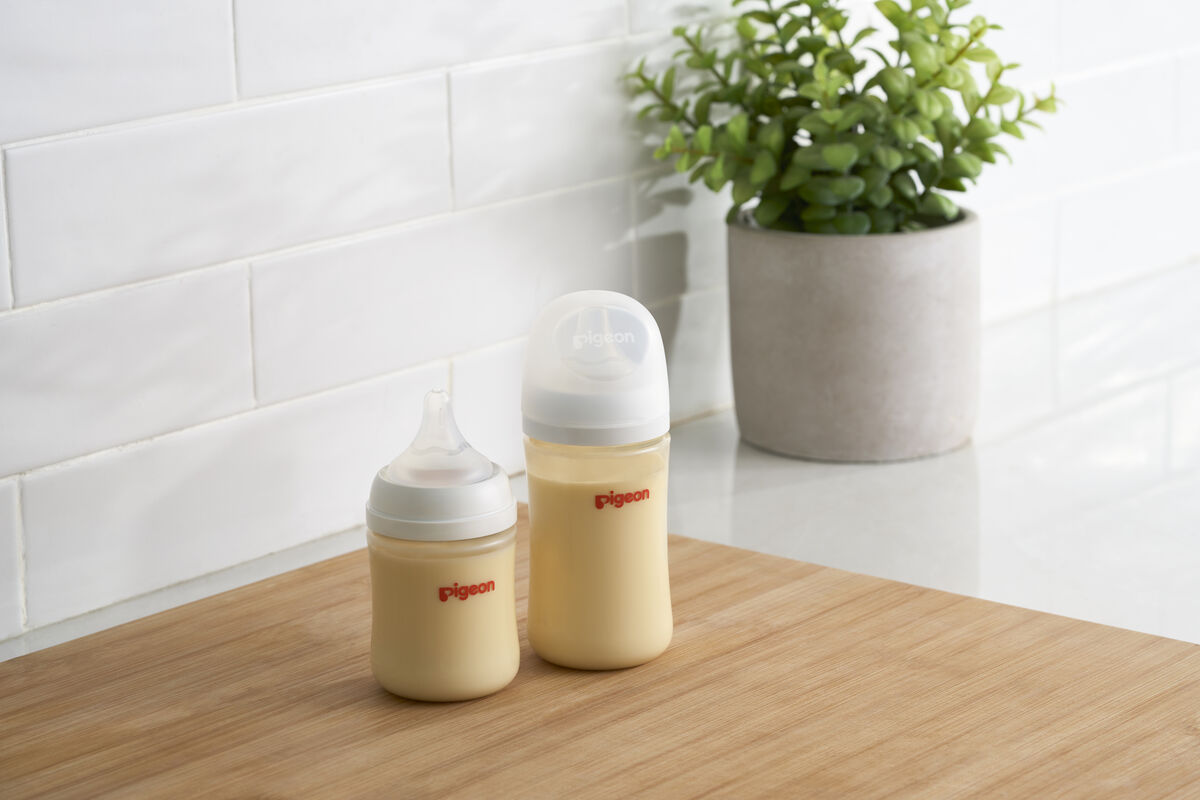
You've probably found yourself staring at the packaging on a teat, wondering whether the age printed on it actually applies to your baby. Some babies fly through feeding milestones early, others take their time, and most parents end up guessing somewhere in between. It's one of those quietly stressful questions that doesn't come with a clear answer, because there isn't one number that works for every baby.
Here at Pigeon, we hear this question constantly, and the honest answer is that age guides are a starting point, not a rule. Your baby's feeding behaviour tells you far more than the calendar does. A baby who is working hard to get milk out, or who has started eyeing off your cup at the table, is often communicating something specific about their development.
This matters because moving up too early or too late both come with downsides. Progress too soon and your baby may struggle to coordinate sucking and swallowing. Wait too long and feeding can become frustrating, slow, or full of fuss that has nothing to do with hunger. The goal isn't to rush your baby along, it's to notice what they're already telling you.
In this article, we'll walk through the behavioural signs that indicate it's time to move to a new teat size or introduce a straw cup, what can go wrong when timing is off, and how a gradual system like the SofTouch™ Step Up Range can make the whole process feel far less like a guessing game.
Why Age Alone Isn't the Best Guide
Teat packaging and cup boxes use age ranges because they need a general starting point for the average baby. The problem is that no baby is exactly average. Oral development depends on muscle strength, feeding frequency, prematurity, and plenty of individual variation that a printed age range simply can't capture.
This is why two babies at the same age can be at completely different stages. One five month old might already be managing a medium flow teat with ease, while another is still perfectly happy on a slower flow and showing no signs of wanting more. Neither baby is behind or ahead, they're just moving at their own pace.
Health authorities echo this. Raising Children Network notes that babies can typically start learning to drink from a cup from around six months, but the emphasis is on watching your baby's own cues rather than treating that number as a deadline. Babies can start learning to drink from a cup from 6 months, and it helps to start with only a small amount of liquid and try an open cup from early on. [1]
At Pigeon, our SofTouch™ range was built around this understanding. The SofTouch teats come in six sizes, so you're never forced to jump straight from one stage to a stage that's too advanced. Small, gradual steps mean your baby's mouth and swallow reflex have time to catch up with each change.

The Feeding Cues That Signal Readiness
Rather than watching the calendar, it helps to watch your baby during feeds. Their behaviour usually tells you clearly when something isn't quite matching their current stage anymore.
Signs it's time for the next teat size
A baby who is ready to move up a teat size often shows some combination of the following:
- Taking noticeably longer to finish a feed than they used to
- Becoming fussy, frustrated, or pulling off the bottle mid feed
- Sucking so hard the teat collapses slightly
- Finishing feeds but still seeming unsettled or hungry soon after
These are all signs your baby is working harder than they need to for the milk they're getting. Our Choosing the Right Teat Flow guide goes into more detail on how to match teat flow to your baby's developing sucking strength, and it's worth a read if you're not sure where to start.
Signs it's time to introduce a cup or straw
Cup readiness tends to show up alongside solid food readiness, and includes cues like:
- Sitting independently with steady head and neck control
- Reaching for or showing interest in your own cup at the table
- Bringing objects to their mouth with growing coordination
- Starting to manage purees or soft solids well
Raising Children Network points out that these physical skills, sitting steadily and controlling the head, are part of what makes cup drinking safe and manageable for a baby. Learning to drink from a cup strengthens a child's finger, hand, mouth, tongue and jaw muscles, all of which support drinking, eating and speaking later on. [1]
Introducing a drinking cup doesn't mean the bottle disappears overnight. Most babies use both for a while, practising with a cup at mealtimes while still relying on the bottle for the bulk of their feeds.

What Happens If You Move Too Soon or Wait Too Long
Timing matters more than most parents expect. A teat that's too fast for your baby's stage can cause coughing, gulping, or milk coming out faster than they can swallow comfortably. This isn't just annoying for your baby, it can also affect how much air they take in during a feed, which plays into wind and discomfort afterwards. Our Paced Bottle Feeding article explains this connection in more depth.
On the other hand, staying on a flow that's too slow for too long can leave your baby working unnecessarily hard, which sometimes shows up as bottle refusal or a baby who seems to lose interest in feeding altogether. If you're troubleshooting refusal, our Bottle Acceptance guide has practical tips for working through it.
There's also a longer term consideration around bottle weaning itself. Raising Children Network recommends weaning off the bottle by around 12 months, partly because prolonged bottle feeding is linked to a higher risk of tooth decay. Bottle feeding after 12 months can increase children's risk of tooth decay, especially if they're settled in bed with a bottle, because there's less saliva during sleep to protect their teeth from the sugar in milk. [2]
This is exactly why starting the straw and cup transition earlier, even gradually and alongside bottles, gives your baby more time to build the skill without pressure. It's less about switching everything at once and more about giving your baby practice runs well before the bottle needs to go altogether.
Watching Your Baby, Not the Clock
If there's one thing worth remembering through all of this, it's that readiness cues are more reliable than any age printed on a box. Your baby's coordination, appetite, and comfort during feeds will tell you what they need long before a milestone chart does.
It also helps to know that progress isn't always a straight line. A baby might handle a straw beautifully one week and want nothing to do with it the next, especially around teething, illness, or a growth spurt. That's completely normal and doesn't mean you've misread the cues, it just means babies are allowed to have off days too.
Choosing a SofTouch bottle system that lets you move between stages without swapping the whole bottle setup takes some of the pressure off. You can respond to what your baby is showing you in the moment, rather than committing to an entirely new product every time their needs shift.

How the SofTouch™ Step Up Range Supports Your Baby's Progress
The SofTouch™ Step Up Straw Bottle Set was designed around exactly this idea, that progress should happen in stages, not sudden switches. The set includes a training straw top with a round tip for babies from six months, shaped to feel familiar to the SofTouch™ teat your baby already knows, which helps ease the shift from nursing to independent sipping.
As your baby's coordination develops, the set also includes a drinking straw top for babies twelve months and older, with a flat tip that supports bigger sips as their confidence grows. The connector and gravity ball straw allow drinking from multiple angles, so your baby can tip, tilt, and experiment the way toddlers naturally do, while the sealed one piece silicone design keeps everything hygienic between washes.
Because the set is built on the same SofTouch™ 240ml PP bottle body, it's compatible with the wider SofTouch teats collection too, so you're not starting from scratch each time your baby moves forward. For families thinking further ahead, our StarTouch drinking cups continue the same gradual approach into toddlerhood.
What Parents Are Saying
It Works!!
"My son has low muscle tone ( he has Down Syndrome) and has been finding it difficult to make the transition from his pigeon bottle wide neck teats to straw drinking. So far, this step-up kit has worked brilliantly for him! After just two weeks of using it, starting with the first, longer teat that is included in the kit, he held his own bottle of diluted juice today and drank on his own! What a happy 2 year old!! (And his mama too!) Thank you SO much for this product! I'll be recommending it to my son's speech pathologist, who is his feeding therapist."
There's no need to feel like you're falling behind if your baby hasn't moved stages exactly when a chart says they should. Feeding is one of the few areas where slow and steady genuinely does the job better than rushing. The cues are usually there if you know what to look for, and trusting them tends to serve your baby far better than trusting a printed age range.
Give yourself permission to move at your baby's pace, not the pace set by packaging or well meaning comparisons with other babies. Every step forward, whether it's a new teat size or the first proper sip from a straw, is worth acknowledging, even the messy ones.
Related Reading
- Choosing the Right Teat Flow: A Step by Step Guide
- Paced Bottle Feeding: What It Is and Why It Matters
- Bottle Acceptance: Expert Tips to Help Your Baby Transition Smoothly
- Fast Flow vs Slow Flow Baby Bottle Teats: Finding the Perfect Fit
- Wide Neck vs Standard Neck Baby Bottles: Which Is Best for Your Baby?
FAQs About Moving to the Next Bottle Stage
How do I know if my baby needs a bigger teat size?
Watch for feeds that take much longer than usual, fussing partway through, or the teat collapsing while your baby sucks strongly. These are all signs the current flow is too slow for their developing strength. Our SofTouch teats come in six sizes, so you can move up gradually rather than guessing at the right jump.
What age should my baby start using a straw cup?
Most babies show interest in a straw or cup from around six months, often alongside starting solids. Readiness depends more on sitting steadily and showing interest in cups than on a specific birthday, so it's worth watching your baby's cues rather than the calendar. Our Bottle Acceptance guide has more on reading these transition cues.
Can I use a straw top on my current SofTouch bottle?
Yes. The SofTouch™ Step Up Straw Bottle Set is designed to work with the same 240ml SofTouch™ PP bottle body, so you're adding a new stage rather than replacing the whole bottle system.
Is it normal for my baby to go backwards between stages?
Yes, this is common, especially around teething, illness, or a growth spurt. A baby who was managing a straw confidently one week might want the familiar teat again the next. It doesn't mean you've misjudged their readiness, it just reflects the normal back and forth of development. If feeds feel harder than usual, our Choosing the Right Teat Flow guide can help you work out if a flow change is behind it.
When should I start weaning my baby off the bottle completely?
Health guidance in Australia generally recommends weaning off the bottle by around 12 months of age, partly to reduce the risk of tooth decay from prolonged bottle use. Introducing a drinking cup well before this point gives your baby plenty of practice time before the bottle needs to go.