Every feed is a conversation between you and your baby. They signal hunger, you respond, they signal fullness, and you stop. It sounds simple, but when feeding from a bottle, that rhythm can easily get disrupted. Milk flows freely whether your baby is ready or not, and before long the bottle is empty and a full, uncomfortable baby is letting you know all about it.
Paced bottle feeding is a technique designed to put that conversation back at the centre of every feed. It is one of the most practical expressions of responsive feeding, an approach to infant care recommended by both the World Health Organization and the American Academy of Pediatrics as a key strategy for supporting healthy growth and appetite self-regulation from the very start [1]. Whether you are exclusively bottle feeding, combining breast and bottle, or in the process of transitioning from breastfeeding to bottle feeding, understanding this technique can genuinely change your feeding experience.
What Is Paced Bottle Feeding?
When a baby feeds at the breast, they are in control. They latch, suck, pause, swallow, and dictate the pace entirely. Milk does not flow unless they actively work for it. A conventional bottle feed works very differently: milk pools in the teat and flows readily regardless of the baby's cues, meaning the baby has to swallow continuously to keep up.
Paced bottle feeding bridges that gap. By adjusting your position, the bottle angle, and how you respond to your baby's cues during the feed, you allow your baby to lead the pace in the same way they would at the breast. They get to pause, breathe, check in with how full they feel, and decide whether to continue.
It is a small shift in technique with meaningful results, and the evidence supports it.
Why Paced Bottle Feeding Matters: What the Research Shows
A 2024 study published in PubMed evaluated paced bottle feeding against both typical bottle feeding and breastfeeding in a controlled, experimental setting. The findings showed that paced bottle feeding led to significantly longer feeding durations and slower feeding rates than typical bottle feeding, with no significant difference in total milk intake. The researchers concluded that paced bottle feeding provides preliminary evidence for promoting responsive feeding and noted particular benefit in supporting parental sensitivity to infant cues [2].
The broader evidence base for responsive feeding, of which paced bottle feeding is a practical part, also points to long-term benefits. A systematic review published in PMC found that a caregiver's responsiveness to feeding cues is closely linked to infant appetite self-regulation, with non-responsive feeding practices associated with increased rates of weight gain and higher obesity risk during childhood [3]. This research does not suggest that bottle feeding causes harm, but it does make a compelling case for being intentional about how bottle feeds are conducted.
Separately, research on bottle-feeding practices during early infancy found associations between pressured bottle-emptying during the first six months and more controlling parental feeding styles at six years of age, suggesting that how we feed in infancy can shape feeding dynamics well into childhood [4].

The Benefits of Paced Bottle Feeding
It supports appetite self-regulation. Babies are born with the ability to sense hunger and fullness, but they need the opportunity to act on those signals. Paced feeding gives them the time to register satiety before the bottle is already empty, helping to prevent overfeeding and the discomfort that comes with it.
It reduces air intake and digestive discomfort. When a baby gulps milk quickly to keep up with a fast-flowing bottle, they swallow more air in the process. This contributes to gas, bloating, and reflux. A slower, more deliberate feed with regular pauses reduces air intake significantly. Research into preterm infants has shown that paced bottle feeding techniques support improved swallow-breathe coordination during feeds, reducing breathing pauses [5], findings that are relevant to all bottle-fed infants.
It protects breastfeeding. For parents combining breast and bottle, the risk of flow preference is real. Babies may begin to favour the bottle simply because the milk arrives faster and with less effort. Paced feeding removes that advantage by making the bottle require the same active sucking effort as the breast, helping to protect the breastfeeding relationship.
It fosters a healthy long-term relationship with food. Research on responsive feeding suggests that when caregivers consistently respond to hunger and fullness cues from the start, they support the development of healthy eating self-regulation in children, a skill that research links to healthier weight trajectories into adulthood [3].
How to Pace Bottle Feed: A Step-by-Step Guide
Position your baby semi-upright. Hold your baby at roughly a 45-degree angle, supporting their head and neck. Avoid feeding them lying flat, as this can make swallowing harder and increases the risk of ear infections. An upright position naturally slows the flow and encourages active feeding.
Hold the bottle horizontally. Keep the bottle almost parallel to the floor rather than tilted steeply downward. This prevents milk from pooling freely in the teat, so your baby has to actively suck to draw milk, just as they would at the breast.
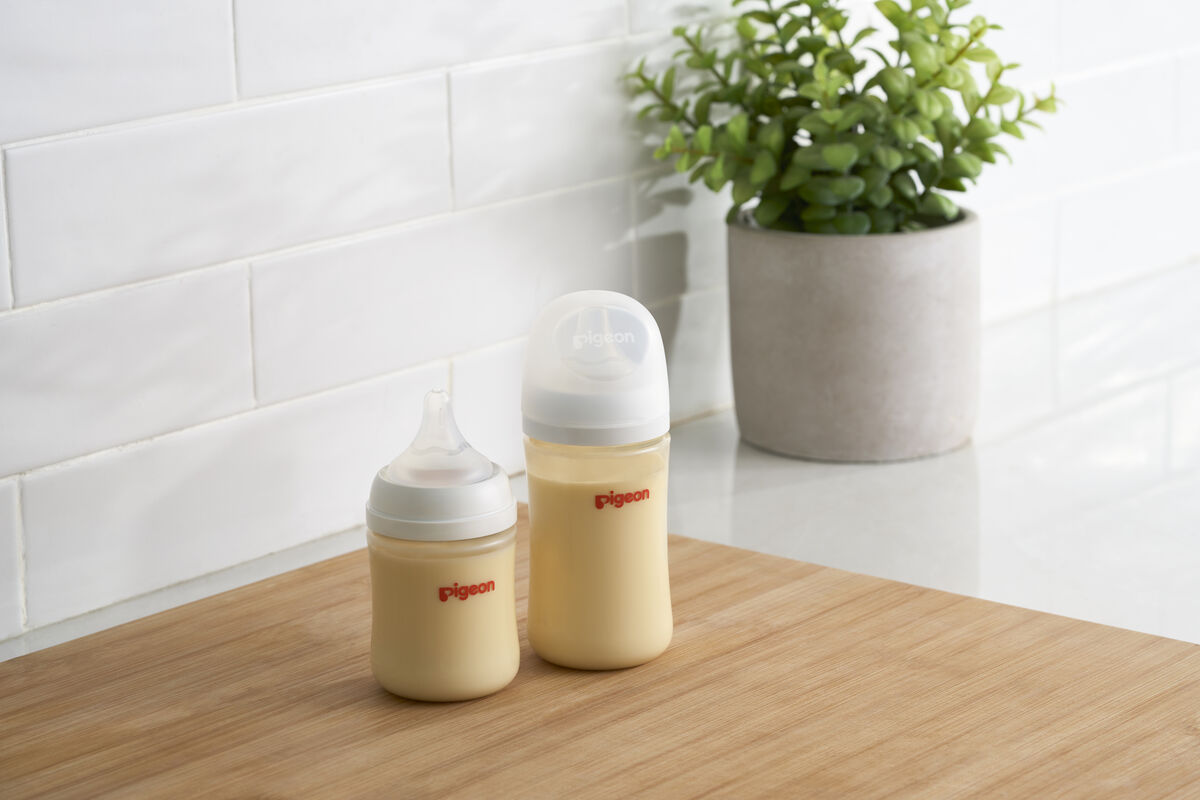
Choose a slow-flow teat. In the early weeks especially, a slow-flow teat is your best friend for paced feeding. It gives your baby control over the flow and enough time to coordinate their suck-swallow-breathe rhythm. The Pigeon SofTouch™ Wide-Neck Bottles and Teats are designed with paced feeding in mind: the Y-cut teat only releases milk when your baby actively sucks, naturally moderating the pace. The wide, breast-shaped teat also supports a deep natural latch, reducing nipple confusion for babies who feed at both breast and bottle. For newborns specifically, the Pigeon SofTouch™ Peristaltic PLUS Teat SS offers the slowest flow in the range, ideal for developing suck-swallow-breathe coordination from birth.
Pause regularly. Every few minutes, gently tilt the bottle down so the teat empties of milk, or remove it from your baby's mouth entirely for a moment. Let them rest, breathe, and swallow. Watch for early fullness cues: turning the head away, slowing the sucking, relaxing the hands, or a faraway gaze. These are your baby's way of saying they need a moment, or that they are done.
Follow your baby's lead. If they re-engage and open their mouth or turn back toward the teat, offer it again. If they turn away, clamp their lips, or arch their back, the feed is finished, regardless of how much milk is left in the bottle. Encouraging a baby to finish the bottle overrides their internal fullness signals and is one of the feeding practices most associated with overfeeding.
Navigating Common Challenges
My baby seems frustrated by the slow flow. Try briefly tilting the bottle to increase flow, then return to horizontal. If frustration is consistent, consider whether it is time to move up a teat size. Babies signal readiness for a faster flow by taking much longer to finish feeds, becoming fussy mid-feed, or collapsing the teat through strong sucking.
Feeds are taking much longer than before. A small increase in feed duration is normal and expected with paced feeding. If feeds are consistently very long, check that the teat size is appropriate for your baby's age and that they are latching correctly onto the full width of the teat, not just the tip.
Holding the bottle horizontally is tiring. Support your arm with a rolled blanket or pillow, or switch arms partway through the feed. It becomes more natural with practice.
My baby is using a bottle with an anti-colic venting system. Venting systems can sometimes interact with a perfectly horizontal hold. Experiment with a very slight tilt while still prioritising slow, paused feeds. The principles of paced feeding still apply.

Choosing the Right Bottle and Teat for Paced Feeding
Not all bottles and teats are equally suited to paced feeding. The key things to look for are a slow or variable-flow teat that requires active sucking, a teat shape that supports a natural latch, and a design that minimises air swallowing.
The Pigeon SofTouch™ range is built around over 70 years of research into infant sucking mechanics. The wide-neck, breast-shaped teat encourages the three key steps of natural sucking, latching, peristaltic tongue movement, and swallowing, and the built-in Air Ventilation System (AVS) helps reduce air intake to minimise gas and colic. Teats are available in six flow rates from SS (newborn) through to LLL (15 months+), so you can keep pace with your baby's developing strength and appetite.
What Parents Are Saying
Highly recommended
Perfect size teat/flow for when bubs is ready for a faster flow. These teats made mix feeding a breeze! Bubs took to the bottle with ease and no nipple confusion! Highly recommended for those who want to to mix feed. We love our pigeon bottles!
- Anonymous, SofTouch™ Peristaltic PLUS Teat SS 1pcs
Great bottles for introduction to bottle feeding
Fantastic product, we were recommended these bottles to introduce to our 6 week old and she took them straight away.
- Hayley, SofTouch™ BPP Bottle PP Twin Pack 160ml
A Note on Combination Feeding
Paced bottle feeding is especially valuable for families navigating both breast and bottle feeding. The technique levels the effort between the two experiences, making it less likely that your baby will develop a strong preference for one over the other based on flow alone. Paired with a breast-shaped teat that supports a natural latch, paced feeding gives you the flexibility to move between breast and bottle without disrupting the broader feeding relationship. For more practical guidance on this, see our tips on bottle acceptance for breastfed babies.
Related Reading
- A Guide to Transitioning from Breastfeeding to Bottle Feeding
- Top Tips: Transitioning from Breastfeeding to Bottle
- Bottle Acceptance: Expert Tips to Help Your Baby Transition Smoothly
- Wide Neck vs. Standard Neck Baby Bottles: Which Is Best for Your Baby?
- Guide to Finding the Right Bottle for Your Baby
FAQ About Paced Bottle Feeding
What is paced bottle feeding and how is it different from regular bottle feeding?
Paced bottle feeding is a responsive technique where the caregiver controls the bottle angle and pauses regularly to allow the baby to set the pace of the feed. In a regular bottle feed, milk flows freely and the baby must swallow continuously. With paced feeding, the baby has to actively suck to draw milk and is given regular breaks to assess their own fullness, much as they would during breastfeeding. Research has shown it leads to slower feeding rates and may support infant appetite self-regulation [2].
Can paced bottle feeding help with reflux?
Yes, it can. Reflux is often worsened by fast feeding that introduces excess air and causes the stomach to overfill quickly. Paced feeding slows the feed, reduces air intake, and allows the baby to stop when full rather than continuing to drink past satiety. Many parents of reflux babies find it reduces the frequency and severity of spitting up. The Pigeon SofTouch™ Bottles include an Air Ventilation System that further reduces air swallowing during feeds.
What teat flow rate is best for paced bottle feeding?
The slowest flow appropriate for your baby's age and strength is generally best. For newborns, the Pigeon SofTouch™ Peristaltic PLUS Teat SS is ideal. As your baby grows and their jaw strength develops, you can gradually move up through the teat sizes. The right flow is one that requires your baby to actively suck but does not cause frustration.
Does paced bottle feeding work when combination feeding?
Absolutely. It is particularly beneficial in this context. By slowing the bottle feed to require the same active sucking as breastfeeding, paced feeding reduces the risk of flow preference, where a baby begins to favour the bottle simply because milk arrives more easily. Paired with a breast-shaped teat, it helps maintain the breastfeeding relationship alongside bottle feeds.
How do I know if my baby has had enough during a paced feed?
Watch for your baby's early fullness cues: slowing the pace of sucking, relaxing their hands, turning their head slightly away, or breaking the latch without re-engaging. These signals appear before the more obvious late cues like crying or arching. When you see them, pause or end the feed. Do not encourage your baby to finish the bottle, as this overrides their natural appetite regulation.