Keeping baby bottles clean feels straightforward enough. Rinse, wash, repeat. But once you become a parent, you quickly realise that "clean" is not a single thing. There is clean as in no visible residue, and then there is clean as in free from bacteria, chemical traces, and anything else your baby's developing system really does not need right now.
Here at Pigeon, we think about this balance constantly. Hygiene matters enormously in the early months. But so does the gentleness of the products you use to achieve it, and so does knowing when enough is enough. The good news is you do not have to choose between rigorous hygiene and a gentle approach. You just need to understand what is actually happening inside that bottle after every feed, and what you are reaching for to address it.
Why Baby Bottles Need More Than a Quick Rinse
Breast milk and infant formula are rich in fats and proteins, which is exactly what a growing baby needs. The problem is that those same fats and proteins cling to bottle surfaces, particularly in hard-to-reach areas like the inside of a teat, the screw-thread groove, and the underside of a valve. A quick rinse under tap water will not cut through that residue.
Health authorities recommend washing all bottle-feeding equipment in hot, soapy water after every feed, using a bottle brush to scrub inside bottles and teats and around caps, discs, rings and screw-top areas, as this is where bacteria are most likely to grow. [1]
Milk residue can harbour bacteria within hours if feeding items are not properly cleaned, which is why thorough washing after every feed matters far more than how many times you sterilise in a day. [2]
For newborns and babies under three months, the stakes are higher. Their immune systems are still developing, which means they are more vulnerable to infections from improperly cleaned feeding equipment. Australian health guidance recommends sterilising bottle-feeding equipment until your baby is at least 12 months old. [1]
So the cleaning step matters. But equally important is what you are cleaning with, and how much you are doing it.
The Myth of More: Why Overcleaning Does Not Equal Safer
There is a very understandable anxiety that drives new parents to sterilise multiple times a day, rewash bottles that have already been cleaned, or reach for the harshest products available in the belief that stronger means safer. It is the parental instinct to protect doing what it does best: pushing you slightly past what is actually necessary.
But overcleaning has its own costs, and it is worth being honest about them.
Sterilising is not a replacement for washing. If milk residue is left inside a bottle and you run it through a steriliser, the residue remains. Sterilisation kills microorganisms on clean surfaces; it cannot penetrate through organic matter. This means the single most important cleaning action you take is the physical scrub with a good cleanser after every feed, not how frequently you sterilise on top of that. [2]
Beyond technique, there is the question of what you are using to clean. Many parents default to whatever dishwashing liquid is beside the sink. It is already there, it makes bubbles, it seems to work. However, most conventional dish soaps are not formulated with babies in mind. They contain synthetic fragrances, dyes, sulfates, and preservatives that can leave residue on bottle surfaces even after a thorough rinse. Over hundreds of feeds in a year, that residue adds up.
Reaching for a harsher or more antibacterial formula does not solve the problem either. Antibacterial agents are not necessary for cleaning baby bottles and may disrupt the natural balance of beneficial bacteria your baby's gut is working to establish. [3]
The more useful question is not "how much am I cleaning?" but "am I cleaning correctly, and with something genuinely safe?"

The Problem With Regular Dishwashing Liquid
Regular dish soaps often contain fragrances, dyes, antibacterial agents, and preservatives that leave residues on bottles. Baby-specific dishwashing liquids minimise these risks while effectively removing milk residue.
Some of the most common concerns with conventional dish soaps include:
Sulfates (SLS and SLES): These foaming agents create the satisfying lather we associate with a thorough clean, but they can leave a film on bottle surfaces even after rinsing. They have been linked to skin irritation and digestive sensitivity, which is a real concern when trace amounts end up in your baby's next feed.
Synthetic fragrances: Scented dish soaps can be absorbed into silicone teats, affecting the smell and taste of the bottle. Some babies will simply refuse to feed from a bottle that smells like dishwashing liquid, and that refusal is often misread as bottle rejection when the real issue is the residue left behind by an unsuitable cleanser.
Phosphates: These are found in many household cleaning products and have been linked to environmental harm as well as potential irritation. Most baby-specific cleansers exclude them entirely.
Residue that does not fully rinse: Many conventional dish soaps do not fully rinse away, leaving a thin chemical film that your baby then ingests with every feed. With a low-suds, food-grade formula, this risk is significantly reduced.
What "Food-Grade" Actually Means
You will see the term "food-grade ingredients" used to describe Pigeon Liquid Cleanser, and it is worth understanding what that actually means in practice.
Food-grade ingredients are approved for direct contact with food. They meet a higher safety standard than general cleaning agents because they are held to the same scrutiny as something you would consume. In the context of a baby bottle cleanser, this matters a great deal. No matter how thoroughly you rinse, trace amounts of cleanser will remain on bottle surfaces. That is simply the reality of washing anything. With a food-grade formula, those traces are not a cause for concern.
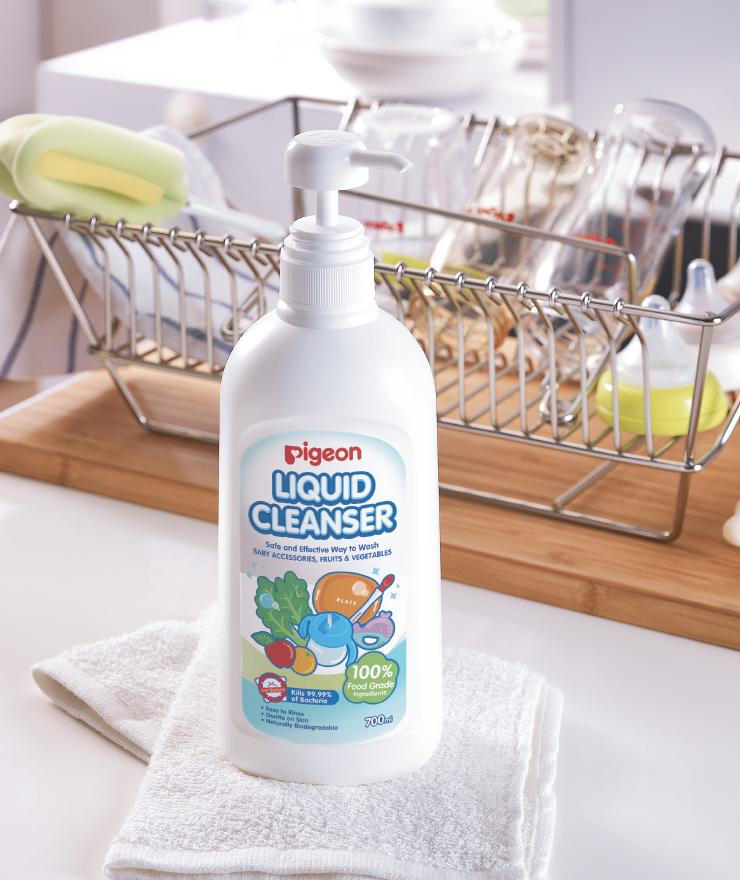
Pigeon Liquid Cleanser is made from naturally biodegradable, food-grade ingredients. Free from sulfates, phosphates, and harsh irritants, this baby-safe detergent uses a low-suds formula that rinses off efficiently. A baby bottle cleanser formulated this way kills 99.99% of bacteria while remaining gentle enough to use on fresh fruit and vegetables before your baby starts solids. That reflects the formulation philosophy behind it: effective where it needs to be, and nothing more aggressive than necessary.
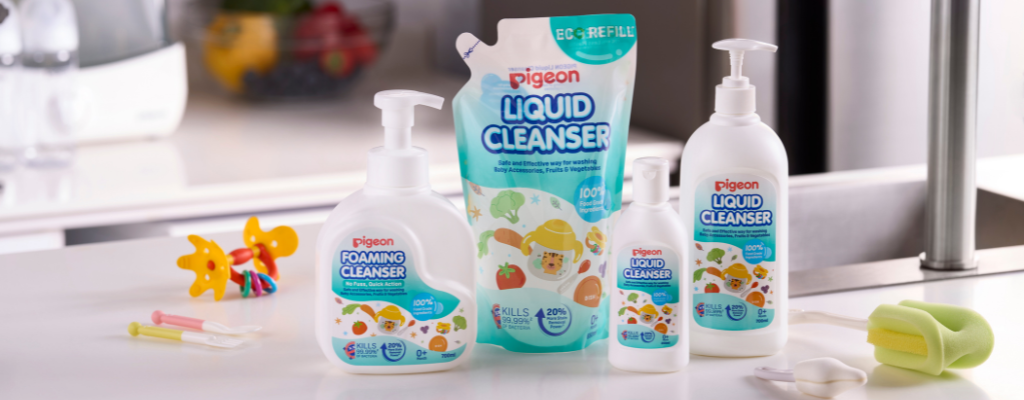
Available in a 450ml bottle for everyday use, a 700ml bottle for larger households, and a 650ml refill to reduce waste, this baby-safe cleaning solution fits into whatever routine works for your family.

Getting the Balance Right: A Practical Cleaning Routine
The goal is not to clean obsessively. It is to clean consistently, correctly, and with the right product. Here is a routine built around that principle:
After every feed: Disassemble all parts of the bottle including the bottle itself, teat, ring, cap, and any valves. Rinse under running water immediately to prevent milk from drying and hardening inside the components. Apply a small amount of Pigeon Liquid Cleanser directly to a dedicated bottle brush or soft sponge and scrub all surfaces thoroughly, paying particular attention to the inside of the teat and the screw-thread area. Rinse under running water until no suds remain. Air-dry on a clean surface rather than patting dry, as cloths can transfer bacteria back onto freshly washed items.
Sterilise regularly, not constantly: Sterilising comes after washing, not instead of it. Running equipment through a steriliser without washing first leaves milk residue in place. A consistent routine of washing after every feed, combined with regular sterilisation, is far more effective than sterilising multiple times a day without attention to the wash step. It's important to sterilise all your baby's feeding equipment, including bottles and teats, until they are at least 12 months old. [3]
Keep your tools dedicated: Use a bottle brush that is reserved solely for bottles, and replace it when the bristles wear. Shared kitchen sponges carry a significant bacterial load and should never contact feeding equipment.
Use the right amount of cleanser: More soap does not mean more clean. A small amount of Pigeon Liquid Cleanser goes a long way, particularly with the low-suds formula designed for efficient rinsing. Excess cleanser only means more rinsing time and greater potential for residue.
What else can you clean with Pigeon’s Liquid Cleaner?
One of the underrated qualities of Pigeon Liquid Cleanser is its versatility. Because it is made from food-grade ingredients, it is safe to use across everything your baby puts in their mouth:
- Baby bottles and teats of all materials, including glass, PPSU, and silicone
- Pacifiers and dummies
- Breast pump parts, including flanges and valves
- Baby toys
- Fresh fruit and vegetables before serving
This is not a product that lives in the cupboard and only comes out during full sterilisation sessions. It is a daily-use cleanser built for the full scope of what babies interact with, which means fewer products cluttering your bench and one less decision to make during an already full day.
Related Reading
FAQs About Cleaning Baby Products Without Overdoing
How often should I wash my baby's bottles?
Every bottle should be washed after every single feed without exception. Rinse immediately after feeding to prevent milk drying inside the components, then wash thoroughly with a baby-safe cleanser like Pigeon Liquid Cleanser before sterilising. Milk creates an ideal environment for bacteria to multiply quickly, and prompt washing is the single most effective thing you can do to reduce that risk.
Do I need to sterilise after every single wash?
Not necessarily, and this is where a lot of parents overcomplicate their routine. The wash step is the most critical part of keeping bottles safe. For healthy babies over three months, daily sanitising may not be required if bottles are cleaned carefully after every use. For newborns and babies under three months, or those born prematurely, more frequent sterilising is recommended. Follow guidance from your health professional based on your baby's specific needs.
Can I use regular dish soap to clean baby bottles?
You can, but it is not the ideal choice. Most regular dish soaps contain synthetic fragrances, dyes, sulfates, and preservatives that can leave residue on bottle surfaces. A purpose-built cleanser using food-grade ingredients, like Pigeon Liquid Cleanser 700ml, is the safer and more effective choice for daily bottle washing, particularly in the newborn months.
Is Pigeon Liquid Cleanser safe if some residue stays on the bottle after rinsing?
Yes. Because Pigeon Liquid Cleanser is made from 100% food-grade ingredients, any trace amounts remaining after rinsing are safe for babies. This is what distinguishes it from conventional dishwashing liquid. Its low-suds formula also makes thorough rinsing easier, further minimising residue from the outset.
What else can I use Pigeon Liquid Cleanser on besides bottles?
Quite a lot. It is suitable for cleaning teats, pacifiers, breast pump parts, baby toys, and even fresh fruit and vegetables before introducing solids. Because it uses food-grade ingredients, it is safe across anything your baby puts in their mouth. The Pigeon Liquid Cleanser 650ml refill is a practical choice for families who use it regularly across multiple purposes.